

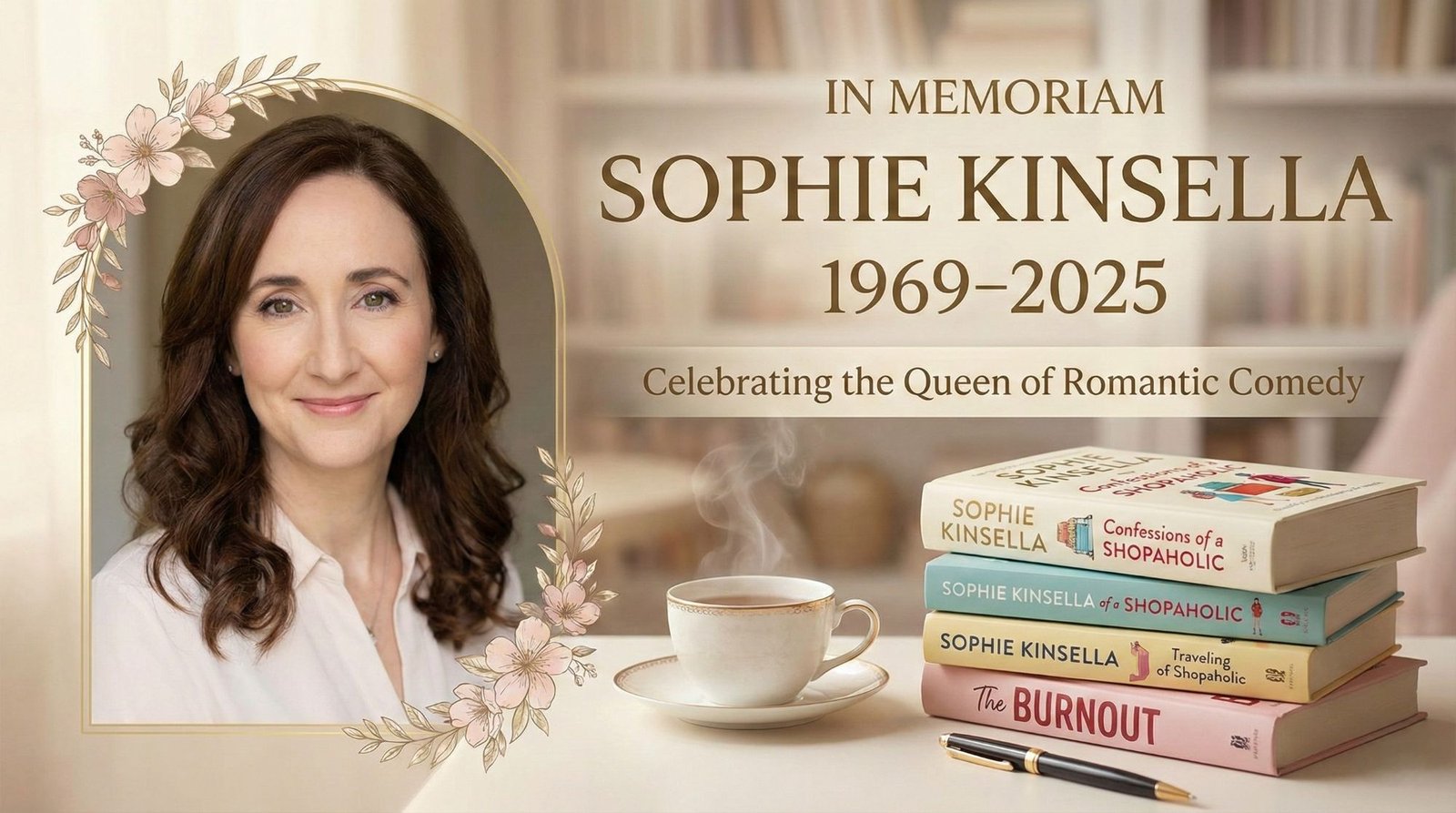
The world of contemporary literature has dimmed with the passing of Sophie Kinsella, the effervescent British author whose wit, warmth, and unparalleled storytelling redefined the romantic comedy genre for a generation. On December 10, 2025, news broke via The Guardian and other major outlets that the author—born Madeleine Sophie Wickham—had passed away at the age of 55 following a courageous battle with glioblastoma.
As tributes pour in from fellow authors like Jojo Moyes, who crowned her the “queen of romantic comedy,” and stars like Isla Fisher, it is clear that Kinsella was not merely a bestseller; she was a cultural touchstone. For over two decades, she acted as a mirror to our own anxieties, framing the chaos of modern life—debt, career mishaps, and messy relationships—with a humor that made us feel seen rather than judged. This comprehensive retrospective explores her life, her breakthrough, and why Sophie Kinsella will remain a titan of fiction long after her final chapter.
The Woman Behind the Wit
Born Madeleine Sophie Townley on December 12, 1969, in London, the future literary icon grew up in a household that valued creativity and education. The eldest of three sisters, she attended Putney High School and showed early promise as a talented pianist. She went on to study Music at New College, Oxford, but eventually switched her focus, graduating with a degree in Politics, Philosophy, and Economics (PPE).
It is a detail often cited with irony that the creator of Becky Bloomwood—literature’s most financially chaotic heroine—began her career as a financial journalist. Working for publications like Pensions World, she spent her twenties demystifying fiscal concepts. This background provided her with a unique arsenal: she understood the dry, intimidating world of finance well enough to satirize it brilliantly.
In her personal life, she was grounded by her partnership with Henry Wickham, whom she married in 1991. Henry, a former headmaster, eventually became her manager, creating a husband-and-wife team that navigated her global success while raising five children. Their private life in Dorset and London was famously guarded, a quiet sanctuary contrasting the high-octane adventures of her characters.
Madeleine Wickham vs. Sophie Kinsella
To understand her success, one must recognize that she effectively managed two distinct literary careers.
The Madeleine Wickham Years (1995–2001)
At just 24, she published her first novel, The Tennis Party (1995), under her real name. These early novels—including The Gatecrasher and Cocktails for Three—were acclaimed for their ensemble casts and slightly darker, social satire. They were successful, certainly, but they were not the global juggernauts that would follow.
The Birth of a Pseudonym
In 2000, seeking to write something more voice-driven and comedic, she submitted a manuscript to her publishers anonymously. She chose the pseudonym Sophie Kinsella, combining her middle name with her mother’s maiden name. The manuscript was The Secret Dreamworld of a Shopaholic. Her publishers, unaware that their established author Madeleine Wickham was behind it, snapped it up. When the truth was revealed in 2003, it added a layer of intrigue to a brand that was already exploding in popularity.
The Shopaholic Series: Anatomy of a Phenomenon
The Shopaholic novels are widely regarded as her magnum opus. The series introduced the world to Rebecca “Becky” Bloomwood, a financial journalist who dispenses advice she cannot follow and soothes her anxieties with Visa cards.
The series includes ten core titles:
- The Secret Dreamworld of a Shopaholic (2000)
- Shopaholic Abroad (2001)
- Shopaholic Ties the Knot (2002)
- Shopaholic & Sister (2004)
- Shopaholic & Baby (2007)
- Mini Shopaholic (2010)
- Shopaholic to the Stars (2014)
- Shopaholic to the Rescue (2015)
- Christmas Shopaholic (2019)
Why Becky Bloomwood Mattered
Critics initially labeled the series as “chick-lit,” a term that often diminished the craft involved. However, Sophie Kinsella created something complex in Becky. She was not just a “ditz”; she was an optimist battling the predatory nature of consumer capitalism. The series didn’t just laugh at Becky; it empathized with the dopamine hit of a new scarf and the sinking dread of a bank statement. This relatability is why the books sold over 45 million copies and were adapted into the 2009 blockbuster film Confessions of a Shopaholic, starring Isla Fisher.
Analysis of Writing Style: The “Kinsella Effect”
Literary analysts and casual readers alike agree that Sophie Kinsella possessed a distinctive voice that is difficult to replicate. Her writing style was built on three key pillars that cemented her status as an expert in the genre.
1. The Internal Monologue
Kinsella mastered the first-person narrative. Her characters’ internal thoughts were often frantic, contradictory, and hilarious, mirroring the way real people think. In Can You Keep a Secret?, the protagonist Emma Corrigan spills her secrets to a stranger on a plane—a scenario that works only because Kinsella captures the sheer panic of the moment so viscerally.
2. Slapstick and Situational Comedy
Few authors could write physical comedy as effectively. Whether it was a character trying to shove a duvet into a cupboard while a handsome stranger watched, or navigating a mud-soaked glamping trip, Kinsella’s set-pieces were cinematic in their execution.
3. Emotional Resonance
Beneath the humor lay a foundation of genuine heart. Her novels frequently tackled serious issues such as professional burnout (The Burnout), the ethics of AI and social media (The Undomestic Goddess, I’ve Got Your Number), and family estrangement. She balanced the light and dark, proving that comedic fiction could still carry emotional weight.
Cultural Impact and Global Influence
Sophie Kinsella did not just ride the wave of the early 2000s literary boom; she helped steer it. Along with peers like Marian Keyes and Helen Fielding, she transformed “chick-lit” from a marketing label into a valid, respected exploration of modern womanhood.
- Redefining the Heroine: Before Kinsella, romantic heroines were often passive. Kinsella’s women were proactive, even in their mistakes. They started businesses, confronted bosses, and eventually saved themselves.
- Global Reach: Her work transcended borders, being translated into over 40 languages. In countries as diverse as Germany, Japan, and the US, the archetype of the “well-meaning but overwhelmed modern woman” resonated universally.
- Influence on New Authors: Contemporary writers such as Emily Henry and Beth O’Leary have cited the “Kinsella standard” of blending wit with vulnerability as a major influence on their own careers.
Awards and Recognition
Her contribution to literature was recognized repeatedly throughout her career.
- British Book Awards: Shortlisted for “Author of the Year” (2025).
- Notable Books: The New York Times listed her work among its “Notable Books of the Year” in 2024.
- Bestseller Status: She was a fixture on The Sunday Times and The New York Times bestseller lists for over twenty years, a testament to her enduring appeal.
Courage in the Face of Adversity
The final years of Sophie Kinsella were marked by a bravery that awed her fanbase. In April 2024, she revealed she had been diagnosed with glioblastoma in late 2022. She chose to keep the diagnosis private for over a year to protect her children and process the “new normal.”
Despite the aggressive nature of the illness, she continued to write. Her 2023 novel, The Burnout, was a timely examination of exhaustion that resonated with a post-pandemic world. However, her most poignant work was her final novella, What Does It Feel Like? (October 2024).
Breaking the fourth wall of fiction, this semi-autobiographical work described a writer’s journey with a brain tumor. It was widely praised by critics and readers for its unflinching honesty and—miraculously—its humor. It stands as a powerful final testament to her belief that even in the darkest times, there is room for love and laughter.
Conclusion
As the news of her death on December 10, 2025, settles, the literary community is left to reflect on a career that brought joy to millions. Sophie Kinsella was more than the sum of her sales figures. She was a companion to readers on their commutes, on their holidays, and in their moments of loneliness.
She taught us that it is okay to not have it all together. She validated the messy, chaotic, wonderful experience of being human. While there will be no new adventures for Becky Bloomwood, the existing library of Sophie Kinsella novels remains a beacon of comfort. As her family stated, her final days were filled with “music and warmth and Christmas and joy”—a fitting end for an author who spent her life giving those exact gifts to the world.
FAQ
1. When did Sophie Kinsella pass away?
Sophie Kinsella died on December 10, 2025, at the age of 55, surrounded by her family.
2. What was the cause of Sophie Kinsella’s death?
She passed away following a long battle with glioblastoma, an aggressive form of brain cancer, which she was diagnosed with in late 2022.
3. Is Sophie Kinsella her real name?
No, her real name was Madeleine Sophie Wickham. She wrote seven novels as Madeleine Wickham before adopting the pseudonym Sophie Kinsella for the Shopaholic series.
4. How many children did Sophie Kinsella have?
She is survived by her husband, Henry Wickham, and their five children.
5. What is considered Sophie Kinsella’s most famous book?
The Secret Dreamworld of a Shopaholic (also known as Confessions of a Shopaholic) is her most famous work, launching her career and inspiring a Hollywood film.
6. Did Sophie Kinsella write any books about her cancer?
Yes. Her final novella, What Does It Feel Like? (2024), is a semi-fictionalized, deeply personal account of living with a brain tumor diagnosis.
Read More: Britishheadline.co.uk