

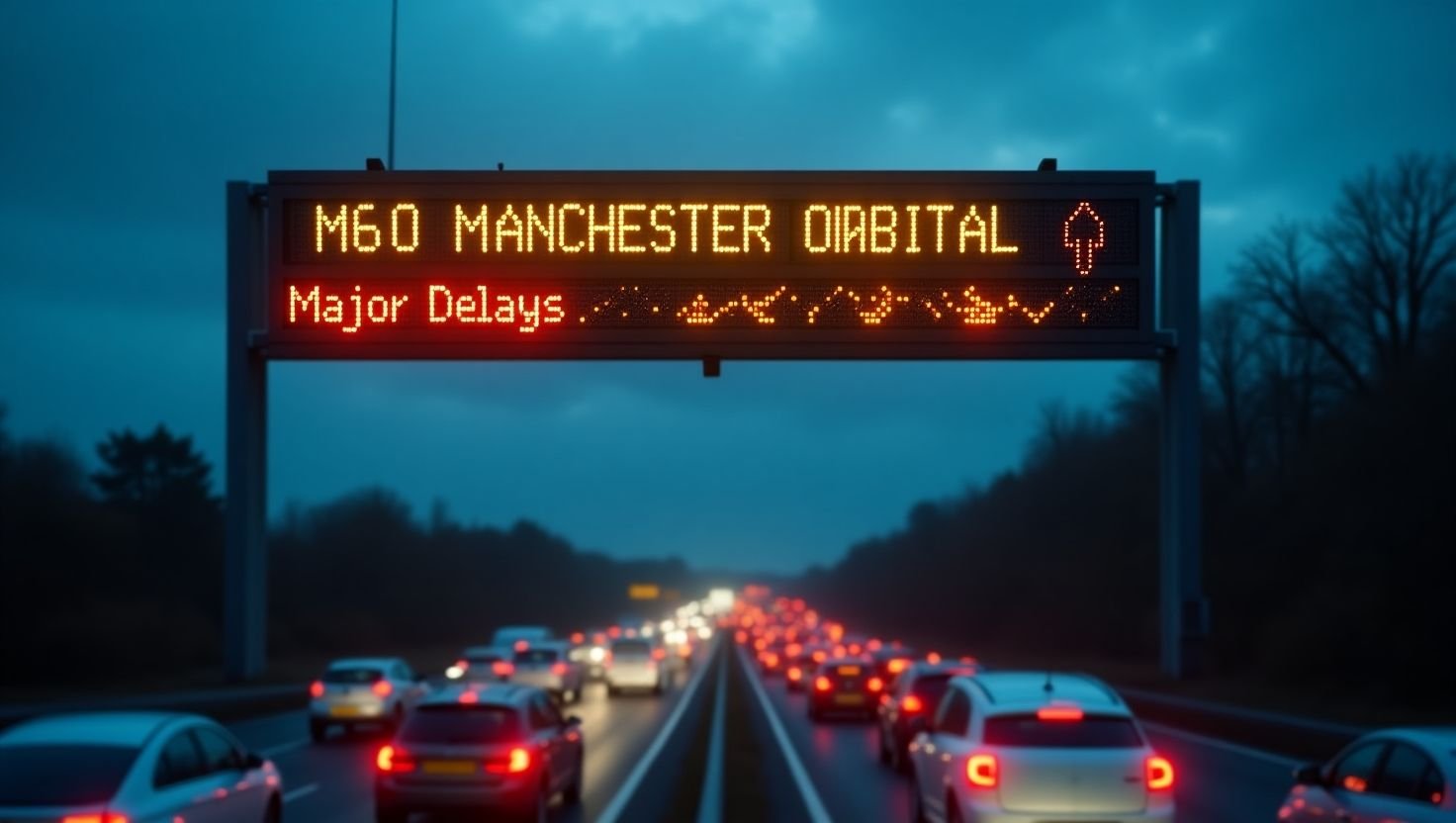
The M60 motorway remains one of Britain’s most problematic traffic corridors, with recent incidents highlighting the ongoing challenges faced by the 180,000 drivers who use this vital Manchester orbital route daily. From emergency service delays to major safety works, M60 traffic continues to dominate headlines as authorities struggle to balance capacity with safety.
Sunday’s dramatic scenes on the M60 near Sale perfectly illustrated the growing problems with motorway safety protocols. Emergency services responding to a welfare concern found their efforts hampered by “idiot” drivers who abandoned their vehicles and blocked the hard shoulder. The incident, which saw a complete closure of the clockwise carriageway between junctions six and eight, left motorists stranded for hours while M60 traffic ground to a complete halt.
Greater Manchester Fire and Rescue Service confirmed their crews arrived at approximately 4:45 PM to assist with reports of a man on the wrong side of the bridge. However, their response was significantly delayed by drivers illegally using the hard shoulder, creating what one frustrated motorist described as a “traffic jam within a traffic jam” that severely disrupted M60 traffic flow.
The incident underscores a persistent problem on smart motorways where the hard shoulder doubles as a running lane during peak times. When the stopped vehicle detection system failed across multiple motorways in February 2023, including sections of the M60, drivers in broken-down vehicles became “sitting ducks” according to AA president Edmund King, further complicating M60 traffic management.
National Highways has embarked on an ambitious £30 million safety improvement programme that will see significant disruption to M60 traffic well into August 2025. The most substantial project involves replacing steel safety barriers with concrete alternatives between junctions 16 and 18, a stretch that passes through some of Greater Manchester’s busiest areas.
The works, which began in May, require a continuous 50mph speed limit and narrow lanes in both directions. Traffic management extends from Junction 16 at Clifton to east of Junction 17 near Prestwich, affecting thousands of daily commuters and creating persistent delays in M60 traffic patterns. National Highways warns that minor delays are expected throughout the project’s duration.
Coordinated resurfacing works at Junction 17 add another layer of complexity. Bury Council’s £650,000 roundabout improvement scheme requires overnight closures between 16 June and 4 July, with traffic accessing the M60 from different approaches during each phase, further disrupting normal M60 traffic flows.
The M60’s performance directly affects Greater Manchester’s economic vitality. Government studies reveal the motorway provides crucial connectivity between labour markets and employment opportunities, while supporting business-to-business relationships across the Liverpool-Manchester-Leeds corridor. The route also serves Manchester Airport and major leisure destinations like the Trafford Centre.
Traffic data shows the M60/M62 interchange handles approximately 305,450 vehicles daily, making it the fourth busiest motorway intersection in the United Kingdom. The M60/M66 interchange processes 249,750 vehicles daily, while the M60/M56 junction sees 218,900 vehicles. These figures demonstrate the motorway’s critical role in regional connectivity and explain why any disruption to M60 traffic has such widespread consequences.
In 2004, the stretch between junctions 16 and 17 recorded 181,000 vehicles per day, temporarily making it the UK’s busiest road section. This volume approached the motorway’s projected maximum capacity almost immediately after its completion in 2000.
Greater Manchester’s first smart motorway became fully operational in July 2018, covering the route from M60 junction 8 to M62 junction 20. The system uses variable speed limits and converts hard shoulders to running lanes during peak periods, theoretically improving traffic flow for the route’s 180,000 daily users.
The technology includes 77 electronic signs, 216 signals, 47 monitoring cameras, and three emergency refuge areas. However, the February 2023 system failure exposed vulnerabilities when software problems froze signs and deactivated stopped vehicle detection across multiple smart motorway sections.
National Highways invested heavily in the infrastructure, installing enough low-noise surfacing to cover 157 football pitches and 990 replacement lighting columns. The project also included nine superspan gantries and 111 traffic monitoring sites to manage traffic flow.
Transport for Greater Manchester has allocated £1.35 million for corridor management improvements, including new ANPR cameras and GPS-based network monitoring software. The system will provide real-time traffic updates and bus priority sensors at traffic lights.
However, challenges persist with the Manchester North West Quadrant study identifying significant capacity issues between junctions 8 and 18. The Department for Transport commissioned extensive analysis to address congestion problems and develop long-term solutions.
Air quality concerns add another dimension to the traffic crisis. The entire M60 study area falls within Greater Manchester’s Air Quality Management Area, with road transport identified as the primary pollution source. Approximately forty Noise Important Areas exist within the study zone, many located at busy junctions.
The M60’s traffic problems reflect broader challenges facing Britain’s motorway network. With ongoing safety works, smart motorway technical issues, and growing traffic volumes, the situation requires sustained investment and innovative solutions.
Recent incidents demonstrate that technology alone cannot solve the motorway’s problems. Driver behaviour, emergency response protocols, and infrastructure resilience all need improvement. Until these issues are addressed comprehensively, the M60 will likely continue generating headlines for all the wrong reasons.
For now, drivers must plan carefully, allow extra time for journeys, and follow traffic management instructions. The alternative – as Sunday’s chaos demonstrated – is gridlock that affects not just individual journeys but the entire Greater Manchester transport network.
Read More: Man utd Transfer Today News: Latest Updates on Summer Rebuild